The Passive House
Using smart design to increase comfort and lower energy requirements.
Passive House Principles
Passive buildings are built using a set of design principles developed using a scientific approach. The focus of which is on attaining a measurable level of energy efficiency and comfort through a 'fabric first' design philosophy.
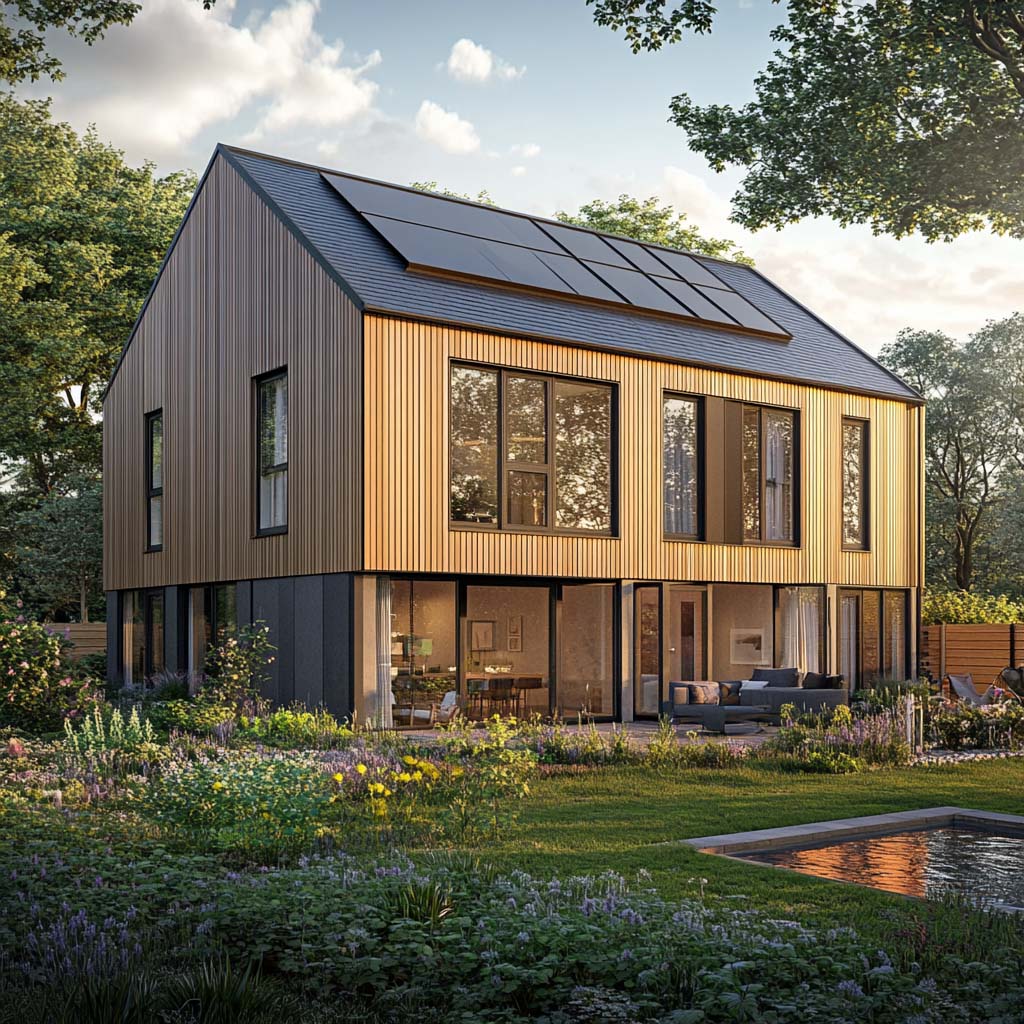
The principles behind PassivHaus Construction
An airtight building envelope ensures that there are as few gaps and cracks between the internal and external building environment. This enables the occupant to maintain full control over the internal environment. This contributes to significant improvements in thermal comfort inside the building.
Using quality and sufficient insulation in the construction of the building allows for good thermal separation. This allows for separation between the external environment and the heated or cooled conditions in the internal environment. This improves thermal comfort inside the building and reduces the risk of condensation.
Installing mechanical ventilation allows the recovery of heat and the delivery of fresh filtered air. It does this without creating uncomfortable drafts, and without creating excessive demand on other heating and cooling systems.
Windows are another area where quality insulation can improve the energy efficiency of the building. Installing low emissivity glass with double or triple glazing along with non metal frames to reduce thermal breakages.
The size of the windows being appropriate to each orientation, allowing solar radiation to penetrate during winter months but not too much during the summer months. Making certain the windows are also properly sealed. It all contributes to the energy efficiency of the building.
Thermal bridging refers to the transmission of heat from one part of the building to another. The aim is to maintain control over the internal environment and manage how heat and cold move from the inside of the building to the outside.
As such insulation needs to be sufficient in thickness but it also needs to be continuous. Any break in the insulation can reduce the effectiveness of the insulation and result in thermal bridging.
Where it is impossible to further reduce the efficiency of the insulation then combining it with materials that do not conduct heat as well. Using timber instead of metal or strategically designing thermal breaks in the construction in order to reduce the flow of heat from one conductive material to another.
All of this contributes to higher energy efficiency and reductions in the risk of condensation leading to lower levels of comfort.
Thermal comfort
In summer, indoor temperature may exceed 25 °C for no more than 10% of the hours in a year. This is the overheating frequency criterion assessed for certification.
A minimum of 20 °C in winter is often quoted alongside it. This is the indoor design temperature PHPP assumes when calculating whether the building meets the space heating demand — the standard's claim is that the building holds 20 °C in winter without a conventional heating system, not that it stays below it.
Sources: Passive House Institute, Passive House requirements, passivehouse.com [accessed 15 August 2026]. International Passive House Association, Active for More Comfort: Passive House, 2nd edn, 2014 — criteria table and worked examples.
Why this matters more in Australia.
PHPP calculates overheating frequency for the entire volume inside the building envelope — a single figure averaged across the whole floor area and across the year. A building can pass the 10% test while individual rooms with high solar exposure sit well above 25 °C for extended periods. PHPP also runs on historic climate data, so models should be stress-tested against current and projected climate files rather than the supplied historical set. In Australian conditions, where summer overheating rather than winter heating is usually the binding constraint, both limitations argue for room-level verification in addition to the certification calculation. Elrondburrell Passivhaustrust
Sources: Passive House Institute, Passive House requirements [accessed 15 August 2026]. Passivhaus Trust, Avoiding summer overheating: guidelines for summer comfort in Passivhaus.
Heating and Cooling
Max heating demand of 15kWh/m2/yr or a heating load of 10W/m2. Max cooling demand of 15kWh/m2/yr or a cooling load of 10W/m2 (if installed). Some allowances for humid climates.
Humidity
Humidity estimates not exceeding 12g/kg for more than 20% of the year. This works out to approximately 60% relative humidity at 25°C.
Airtightness
Maximum reading of 0.6ACH50 with on-site verification.
Energy demand
Renewable Primary Energy (PER) demand must not exceed 60 kWh per square metre of treated floor area per year for Passive House Classic. PER covers the total energy used for all domestic applications — heating, hot water and domestic electricity — not heating alone. Passivehouse
An alternative verification route is retained in the PHPP using conventional non-renewable primary energy (PE), where the limit is 120 kWh/(m²a), calculated with a primary energy factor of 2.6 for the electricity mix. These are two different metrics, not two versions of the same one — see the note below. Passivehousenetwork
Source: Passive House Institute, Passive House requirements [accessed 15 August 2026]; PHI, Criteria for the Passive House, EnerPHit and PHI Low Energy Building Standards.
PER and PE: why there are two numbers
Conventional primary energy (PE) asks a present-tense question: how much source energy must be extracted and burned today to deliver the energy this building consumes? It applies a fixed multiplier to grid electricity — 2.6 under the PHPP's standard factor profile — to account for generation and transmission losses in a largely fossil-fuelled supply system.
Renewable Primary Energy (PER) asks a forward-looking question: in a supply system running entirely on renewables, how much renewable generation — including the conversion and storage losses needed to deliver it when the building actually wants it — would this building require?
The practical consequence is that PER weights loads by seasonal timing, not just quantity. A winter heating load in a cold climate must be met from seasonal storage, which carries heavy conversion losses, so it attracts a high PER factor. A load that coincides with abundant summer generation attracts a low one. PE makes no such distinction.
This is why the two figures cannot be compared directly, and why a building can sit comfortably inside one limit while being marginal on the other. PER is the current primary criterion; the PE route exists largely for continuity with buildings assessed under earlier versions of the standard.
What are the benefits of a Passive House
The environment is changing
Building a passive house is about focusing on making a deliberate effort to improving the energy efficiency of the home we live in:
- Reduced demand for energy
- More comfortable living environment
- Better health and wellbeing through improved ventilation and temperature control
- Reduced energy bills
- Reduced reliability on grid infrastructure
- Positive impacts on property values
These are just a few of the benefits of building to the Passivhaus standard. There are so many advantages to improving the design efficiency of our homes and businesses that they will also contribute to better environmental outcomes as we move further into the 21st century.