Money & Finance
Mastering Money and Finance
Money is a tool that gives you leverage — for better or worse. Used poorly, it causes damage. Understood and managed well, it creates freedom and choice.
Whether you work for yourself or someone else, financial literacy is essential for building long-term wealth and security.
Get your free financail toolkit
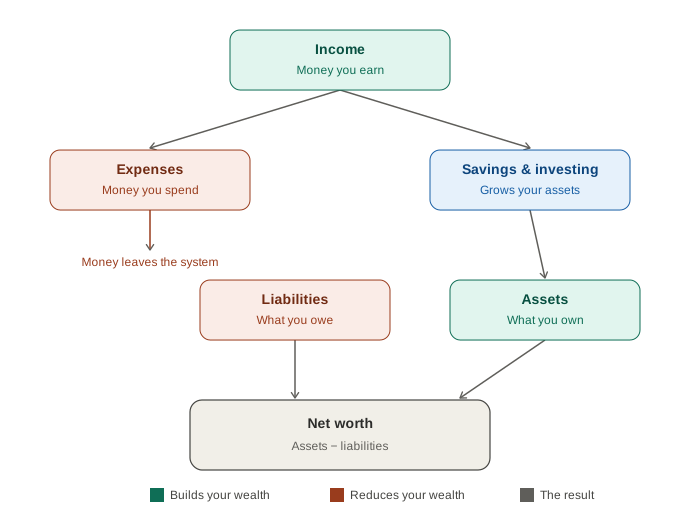


Know Your Numbers: The Building Blocks of Financial Health
Income
Money you earn or receive regularly, such as salary, wages, business profits, or investment returns. Understanding your income helps you plan realistic budgets and identify opportunities to grow your earning potential. Having multiple sources of income is essential.
Assets
Anything you own that has value or generates income, like cash, property, investments, or a business. Understanding your assets shows you what's working for you financially and where to focus efforts to build long-term wealth.
Expenses
The money you spend on goods and services, including fixed costs (rent, bills) and variable costs (groceries, entertainment). Understanding your expenses reveals where your money actually goes, making it easier to cut waste and save more.
Liabilities
Money you owe to others, such as loans, credit card debt, or a mortgage. Understanding your liabilities helps you manage debt responsibly and avoid it eroding your net worth over time.
Financial Literacy Basics
A solid grasp of financial literacy gives your household more freedom, security, and control over the future.
Investing
Investing puts your money to work through assets like stocks, property, or funds, allowing you to grow wealth over time and outpace inflation in a way that saving alone cannot.
Business & Entrepreneurship
Learning the basics of running or investing in a business builds financial independence by opening additional income streams beyond a single salary or job.
Insurance & Risk Management
Insurance and risk management protect your income, assets, and family from unexpected events, ensuring one setback doesn't undo years of financial progress.
Retirement & Long-Term Planning
Planning early for retirement and long-term financial goals ensures your money continues working for you well beyond your working years, giving you security and freedom later in life.
Earning Income
Understanding the different ways you can earn money — from wages and salaries to side hustles and business income — is the starting point of financial literacy and the foundation for every other money decision you'll make.
Budgeting and Cashflow
Budgeting is the practice of tracking what comes in versus what goes out, and mastering it gives you control over your spending, prevents debt, and creates room to save and invest.
Saving
Saving money consistently builds a financial safety net and provides the capital you need to invest, handle emergencies, and work toward long-term goals without relying on debt.
Debt & Credit Management
Understanding how debt and credit work — including interest rates, credit scores, and repayment — helps you borrow wisely and avoid the compounding costs of poor debt decisions.
Frequently Asked Questions
Here you can find some of the most common questions we receive.
-
What is the difference between an asset and a liability?
An asset is something you own that has value or generates income, such as cash, property, or investments, while a liability is money you owe, such as a loan or credit card debt. For households, understanding this difference is essential for building financial resilience — whether that's growing savings, managing a mortgage, or evaluating the long-term value of upgrades like solar panels or energy-efficient appliances.
-
Why is financial literacy important for households?
Financial literacy helps households make informed decisions about earning, saving, investing, and managing debt, which builds greater independence and security over time. It also equips families to navigate broader economic shifts — from rising cost of living to changes in energy prices — so they can adapt their budgets and long-term plans with confidence.
-
What is the differnce between income and cashflow?
Income is the money you earn, while cash flow refers to the movement of money in and out of your accounts, including everyday expenses. Positive cash flow gives households breathing room to save, invest, or plan for larger changes — such as switching to renewable energy sources or reducing reliance on volatile utility costs.
-
How much of my household income should I save each month?
While the right amount depends on personal circumstances, a common guideline is to save at least 20% of household income. Building this into a budget creates a buffer for both everyday needs and longer-term goals, whether that's an emergency fund, education, or investments in more sustainable, cost-efficient living.
-
Where should I start if I want to improve my households financial literacy?
A good starting point is understanding the basics — how income, expenses, assets, and liabilities work together — before moving on to budgeting, saving, and investing. This foundation also helps households evaluate bigger decisions with confidence, such as whether investments in energy efficiency or clean energy technology make sense for their long-term finances.
Download our free toolkit available at the top of this page to get started mapping your current situation.
Earning Income
How much do you need to sell each day?
Setting a revenue target in annual terms makes it easy to lose your grip on the scale of it. "A hundred thousand a year" is an abstraction. "Three hundred and eighty-four dollars, every single weekday, without exception" is a number you can test against reality.
The table below does one thing: it converts an annual gross revenue target into the average daily sales value required to reach it. Find your target in the left-hand column, then read across to the column matching how often you actually trade.
What these figures are — and what they are not
These are gross sales figures, not income. They represent the total value of goods or services leaving your business, before the cost of producing them, before overheads, before tax, and before anything reaches you personally. A business turning over $150,000 a year may take home a great deal or almost nothing, depending entirely on its cost structure. This table is deliberately silent on that question.
Treat it as a scale check, not a forecast.
Why trading days matter more than you'd expect
Most calculations of this kind quietly divide by 365 and stop there. That assumes you sell something every day of the year, including Christmas Day.
Almost nobody does. If you trade at two weekend markets a week, your required takings per trading day are roughly three and a half times the naive daily average. The difference isn't a rounding error — it's the difference between a plan that works and one that was never arithmetically possible.
The columns are therefore: 365 days (continuous, including automated or online sales that run unattended), 261 days (a conventional five-day working year), and 104 days (two trading days per week, 52 weeks).
GST basis
All figures are stated exclusive of GST.
This matters once your turnover approaches $75,000. Under Australian Taxation Office rules, GST registration becomes compulsory when your GST turnover reaches $75,000 or more, or when you start a business expecting to reach that figure in the first year. The threshold is $150,000 for non-profit organisations, and the turnover test itself is measured excluding GST — which is why this table uses that basis.
Once registered, roughly one-eleventh of a GST-inclusive sale price is never yours. It is collected on the ATO's behalf and remitted. If you are pricing GST-inclusive, add approximately 10% to every figure below to arrive at the shelf price you'd need to charge.
Source: Australian Taxation Office — Registering for GST
Gross Revenue Table
| Annual Gross Revenue Target | 7 Days/Wk (365) | 5 Days/Wk (261) | 2 Days/Wk (104) |
|---|---|---|---|
|
$25,000 |
$69 |
$96 |
$241 |
|
$50,000 |
$137 |
$192 |
$481 |
|
$75,000 |
$206 |
$288 |
$722 |
|
$100,000 |
$274 |
$384 |
$962 |
|
$150,000 |
$411 |
$575 |
$1,443 |
|
$200,000 |
$548 |
$767 |
$1,924 |
|
$250,000 |
$685 |
$958 |
$2,404 |
|
$300,000 |
$822 |
$1,150 |
$2,885 |
|
Columns use 365 calendar days, 261 weekdays, and 104 days (52 weeks × 2). All figures GST-exclusive, rounded up." |
Download our simple daily sales calculator free.
What can an individual actually sell?
Every daily figure in the table above has to come from somewhere. There are only two things any individual can sell: a product or a service. Employment is not a third category — a wage is the price paid for a service, with a single buyer on a standing arrangement.
The useful work happens one level down.
Products
A product is something a buyer takes away and owns. The categories differ by what limits how many you can supply.
Physical — limited by materials, space and time. Every unit costs you something to make, so a second buyer is a second cost. Produce, preserves, timber, eggs, tools, furniture.
Digital — limited by nothing. The hundredth copy costs what the first copy cost: effectively zero. Guides, templates, spreadsheets, plans, courses, photographs, designs.
Virtual — limited only by rules you set. You aren't selling a thing, you're selling an entitlement: a licence, a membership place, a booking, a credit. Supply is a decision rather than a constraint.
Services
A service is something a buyer receives but never owns. Three categories, again separated by what's being paid for.
Time — paid for hours worked. Mowing, cleaning, harvesting, labouring, care. Predictable, immediately available, and hard-capped: there are only so many hours, and income stops when you do.
Skill — paid for a result, not the hours it took. Repairs, tutoring, design, assessment, installation, bookkeeping. The same job may take you an hour and someone else a day; the price reflects the outcome.
Access — paid for use of something you already own. Machinery hire, storage, agistment, workspace, accommodation. The asset does the earning, which decouples the income from your hours entirely — but only after the asset is paid for.
The distinction that matters most
Cutting across all six: is the sale finished, or does it recur?
A one-off sale means you start tomorrow at zero. A recurring sale — a subscription, a maintenance arrangement, a repeat customer — means tomorrow's daily figure is partly already met before you begin. Two businesses with identical annual revenue can be in completely different positions depending on how much of it renews without being re-sold.
This is worth deciding deliberately, because it determines whether the numbers below describe a treadmill or a foundation.
How many units per day?
A dollar figure is still abstract. Take your required daily takings from the table above, find the nearest row here, and read across to your price point.
| Required Daily Takings | at $20 | at $50 | at $100 | at $250 | at $1,000 |
|---|---|---|---|---|---|
|
$100 |
5 |
2 |
1 |
1 |
1 |
|
$200 |
10 |
4 |
2 |
1 |
1 |
|
$300 |
15 |
6 |
3 |
2 |
1 |
|
$500 |
25 |
10 |
5 |
2 |
1 |
|
$750 |
38 |
15 |
8 |
3 |
1 |
|
$1,000 |
50 |
20 |
10 |
4 |
1 |
|
$1,500 |
75 |
30 |
15 |
6 |
2 |
|
$2,000 |
100 |
40 |
20 |
8 |
2 |
|
$2,500 |
125 |
50 |
25 |
10 |
3 |
|
$3,000 |
150 |
60 |
30 |
12 |
3 |
|
This table is for illustrative purposes only. The numbers here are examples and can be adjusted to suit your own purposes. Units are rounded up. Where the true requirement is below one unit per day, the cell shows 1. In practice that means intermittent rather than daily sales: a $1,000 product against a $200 daily requirement is one sale every five days, not one every day. Price is the variable with the most leverage here. Reaching $1,000 a day means fifty transactions at $20 or four at $250 — the same revenue, but two entirely different businesses in terms of the customers, handling, and hours involved. Doubling your price halves your unit requirement; doubling your effort does not. |
Get started today!
It only takes a few moments.